
THE COMPLETE GUIDE
You Know What To Say. But Pressure Changes How You Say It.
When pressure rises, many capable professionals find themselves:
staying quiet when they have something to say
over explaining to avoid being misunderstood
replaying conversations long after they've ended
The challenge isn't always knowing what to say.
Often, pressure changes access to what you already know.
Free 5-minute guided exercise designed to help you reduce internal pressure before difficult conversations, meetings, feedback discussions, and other significant interactions.
Why Pressure Changes Communication?
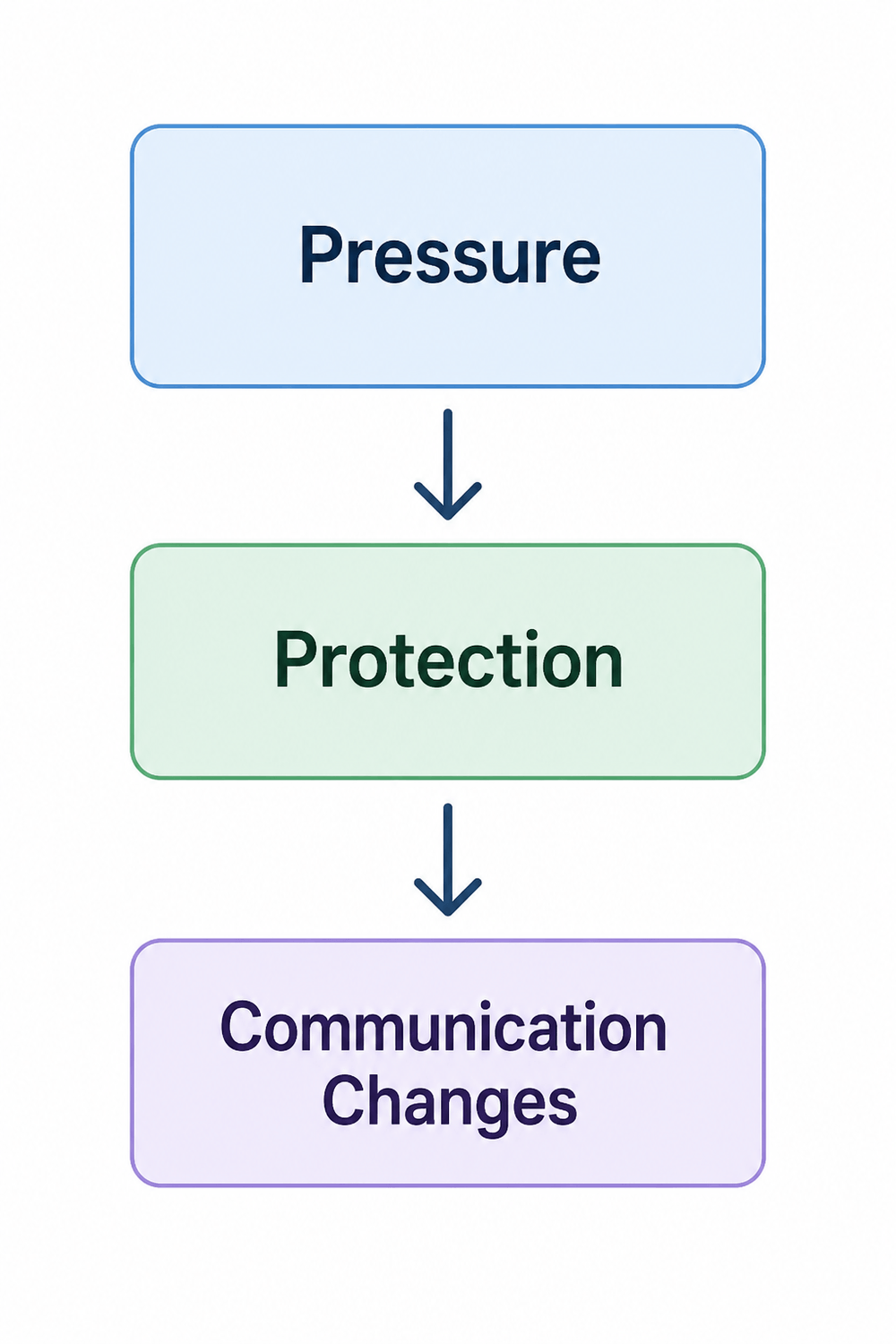
Many people assume communication problems are caused by a lack of confidence, skill, or preparation.
Sometimes that's true.
But it doesn't explain why the same person can communicate clearly in one situation and struggle in another.
A manager may give clear feedback to one employee but avoid giving similar feedback to another.
A professional may contribute confidently in one meeting but stay silent in the next.
A leader may present comfortably to their team but feel themselves becoming hesitant when presenting to senior executives.
The communication skill hasn't disappeared.
Something else has changed.
Often, what has changed is the level of pressure attached to the interaction.
As the perceived consequences of a conversation increase, pressure tends to rise.
You may become more concerned about being judged, misunderstood, rejected, criticised, creating conflict, damaging a relationship, or making the wrong impression.
The conversation starts to feel more significant. As pressure rises, communication often begins to change.
Some people become quieter. Some become more cautious. Some over explain. Some soften their opinions. Some avoid the conversation altogether.
Others continue speaking but find themselves saying things differently than they intended.
This is why communication difficulties are not always a reflection of communication ability.
Many capable professionals already know what they want to say.
The challenge is that pressure can make it harder to access and express that clarity in the moment.
Understanding this distinction can be important.
Because if the problem is assumed to be a lack of confidence or communication skill, the solution often becomes learning more techniques.
But when pressure is the primary factor, a different approach may be needed.
The goal is not necessarily to become more confident.
The goal is to communicate more clearly even when the stakes feel high.
Signs Pressure May Be Affecting Your Communication
Pressure does not affect everyone in the same way.
Some people become quieter. Others become more cautious, more indirect, or more likely to second-guess themselves.
The common thread is that communication begins to change as the perceived consequences of the interaction increase.
Here are some common signs that pressure may be influencing how you communicate.
You have an idea, question, or perspective that could contribute to the conversation, but the moment passes before you speak.
Later, the words come easily.
The challenge wasn't having nothing to say. It was accessing and expressing it in the moment.
[Read: Why Do I Stay Quiet In Meetings Even When I Have Something To Say?]
You start with a simple point but find yourself adding more context, more caveats, and more justification than intended.
What could have been a concise message becomes a lengthy explanation.
The meeting is over.
The call has finished.
Yet part of your attention remains stuck in the interaction, reviewing what was said, what wasn't said, and what you wish you had done differently.
You write the email.
Then edit it.
Then revisit it again later.
What should take a few minutes turns into hours or days as you continue refining the wording.
Before an important discussion, you find yourself running through possible scenarios, responses, objections, and outcomes.
Preparation gradually turns into mental repetition.
You water down recommendations, concerns, or feedback to reduce the possibility of conflict or negative reactions.
The message gets delivered, but not with the clarity you originally intended.
In lower pressure situations, your communication feels natural.
As visibility, responsibility, or scrutiny increase, you find yourself becoming more hesitant, guarded, or self-conscious.
These experiences are often treated as separate problems.
But they may be connected by a common factor.
As pressure rises, communication can begin to change in ways that are easy to miss while they're happening.
FREE AUDIO GUIDE
A 5 Minute Reset Before Difficult Conversations
A short guided audio designed to help reduce internal pressure before important conversations, meetings, feedback, and high-stakes moments.
It includes:
Guided audio reset
One-page explanation
Tapping point chart
If pressure often starts building before important conversations, this exercise was designed for exactly that moment.
The Conversation Starts Before The Conversation Starts
Many people assume communication begins when the first words are spoken.
In reality, important conversations often start much earlier.
They begin in the hours, days, or even weeks beforehand.
A conversation with your manager.
A difficult discussion with a colleague.
An important client meeting.
A piece of feedback you've been meaning to deliver.
Long before the interaction takes place, the mind often starts preparing for it. You imagine how the other person might respond.
You think about what could go wrong. You consider different ways of wording your message.
You replay possible scenarios. You anticipate reactions. You picture the consequences of saying the wrong thing. Sometimes this preparation is useful. But sometimes preparation gradually turns into pressure.
The conversation begins to carry more weight. The stakes feel higher. The consequences feel more significant.
And by the time the interaction arrives, you're no longer responding only to the conversation itself.
You're also responding to everything you've imagined about it.
This helps explain why communication can feel surprisingly difficult in situations that seem straightforward on the surface.
The challenge is not always the conversation. The challenge is the pressure that has accumulated around the conversation before it even begins.
Many of the communication patterns discussed earlier can be traced back to this process.
The delayed email.
The conversation you've been meaning to have for weeks.
The recommendation you decide not to make.
The question you never ask. The feedback you soften.
The message that becomes increasingly difficult to send.
From the outside, these can appear to be separate issues.
But often they share a common starting point. Pressure begins building before the conversation starts.
Understanding this can be helpful because it changes where you focus your attention.
Instead of concentrating only on what you are going to say, it becomes possible to notice what is happening before you say it.
The pressure. The predictions. The imagined outcomes. The significance you've attached to the interaction.
Because communication is influenced not only by the conversation itself, but also by everything that happens in the lead-up to it.
What Becomes Possible When Pressure Has Less Influence?
Many professionals assume the goal is to become more confident, more assertive, or more skilled at communication.
But often the shift is simpler than that.
As pressure has less influence over the interaction, people often notice changes such as:
contributing earlier in meetings
saying what they mean more directly
spending less time replaying conversations afterwards
giving feedback with greater clarity
feeling less need to over-explain
recovering faster after difficult conversations
trusting their judgement more in important moments
communicating more consistently across different situations
The goal is not perfect communication.
The goal is to remain connected to what you already know when the stakes feel high.
Because many capable professionals already have the insight, judgement, and communication ability they need.
Pressure simply makes those qualities harder to access in the moment.
A Simple Place To Start
If pressure often builds before important conversations, it can be helpful to address the pressure before the conversation begins.
That's why I created the 5 Minute Reset Before Difficult Conversations.
It's a short guided exercise designed to help reduce internal pressure before meetings, feedback conversations, presentations, and other high-stakes interactions.
The goal is not to become someone different.
The goal is to access more of what you already know when it matters most.
Related Articles
Communication under pressure can show up in different ways.
The following articles explore some of the most common patterns professionals experience when the stakes feel high.
Why Do I Replay Conversations After They Happen?
Why does a conversation continue running through your mind long after it has ended? Explore the role pressure can play in post-conversation rumination.
Why Do I Stay Quiet In Meetings Even When I Have Something To Say?
Understanding why speaking up can feel difficult in some situations, even when you know exactly what you want to contribute.
Why Do I Over-Explain Under Pressure?
A look at why capable professionals often add more justification, context, and detail than intended when the stakes feel high.
How To Reduce Internal Pressure Before A Difficult Conversation
Practical strategies for recognising and reducing pressure before important conversations take place.
FAQs
Yes. Communication under pressure is not limited to people who are inexperienced or lacking expertise. In many cases, increased responsibility, visibility, or perceived consequences can make communication feel more difficult rather than less.
Not necessarily. Some people experience communication difficulties primarily in specific professional situations, such as presentations, meetings, feedback conversations, or interactions with senior leaders, while communicating comfortably in many other areas of life.
Different interactions carry different levels of significance. Factors such as authority, familiarity, history, expectations, and potential consequences can all influence how much pressure is attached to a conversation.
Yes. Preparation can be helpful, but there is a point where preparation becomes over-preparation. Continually revisiting a conversation can sometimes increase pressure rather than reduce it.
Not always. Communication patterns can change as roles, responsibilities, relationships, and professional demands evolve. A challenge that appears in one stage of a career may not appear in another.
Tapping Success
EFT Practitioner in Melbourne, Australia.
I help capable professionals communicate, decide, and act more clearly under pressure.
Address
Mentone, Melbourne, Australia.
will@tappingsuccess.com


Schedule a Consultation
To schedule a consultation, simply fill out the form below, and I'll get back to you within 24 hours to confirm your appointment and discuss the details of your project further.