
How To Reduce Internal Pressure Before A Difficult Conversation
How To Reduce Internal Pressure
Before A Difficult Conversation
Exploring how pressure can influence communication in meetings, feedback conversations, leadership situations, and other important workplace interactions.
Many people prepare for difficult conversations by focusing on the conversation itself.
They think about what to say.
They rehearse different scenarios.
They anticipate questions.
They imagine possible reactions.
They try to find the perfect way to phrase things.
Sometimes this preparation helps.
Sometimes it creates even more pressure.
You can spend hours preparing for a conversation and still feel tense, uncertain, or overwhelmed when it begins.
Why?
Because preparation and pressure are not the same thing.
You can know exactly what you want to say and still feel significant internal pressure before saying it.
What Creates Internal Pressure?
When people think about pressure before a conversation, they often focus on the conversation itself.
But internal pressure is frequently created by something else.
It is often created by attachment to specific outcomes.
For example:
- needing the other person to agree
- needing to be understood
- needing to avoid criticism
- needing to be seen as competent
- needing the conversation to go smoothly
- needing a particular response
The more important these outcomes become, the heavier the conversation can start to feel.
A conversation about feedback becomes a conversation about approval.
A disagreement becomes a conversation about being liked.
A request becomes a conversation about rejection.
The topic remains the same.
But the weight attached to it grows.
Over time, the conversation can begin to feel much bigger than the actual discussion taking place.
Why Thinking About It Often Doesn't Help
Most people respond to this pressure by thinking harder.
They analyse.
They rehearse.
They mentally review different possibilities.
They try to convince themselves everything will be okay.
The challenge is that internal pressure doesn't always respond to logic.
You can know that a conversation is unlikely to be catastrophic and still feel tense about it.
You can tell yourself not to worry and still find yourself replaying possible outcomes.
This is why many people feel stuck.
They are trying to solve an emotional experience with more thinking.
Sometimes the issue isn't a lack of understanding.
Sometimes the issue is that the emotional charge surrounding the conversation remains unchanged.
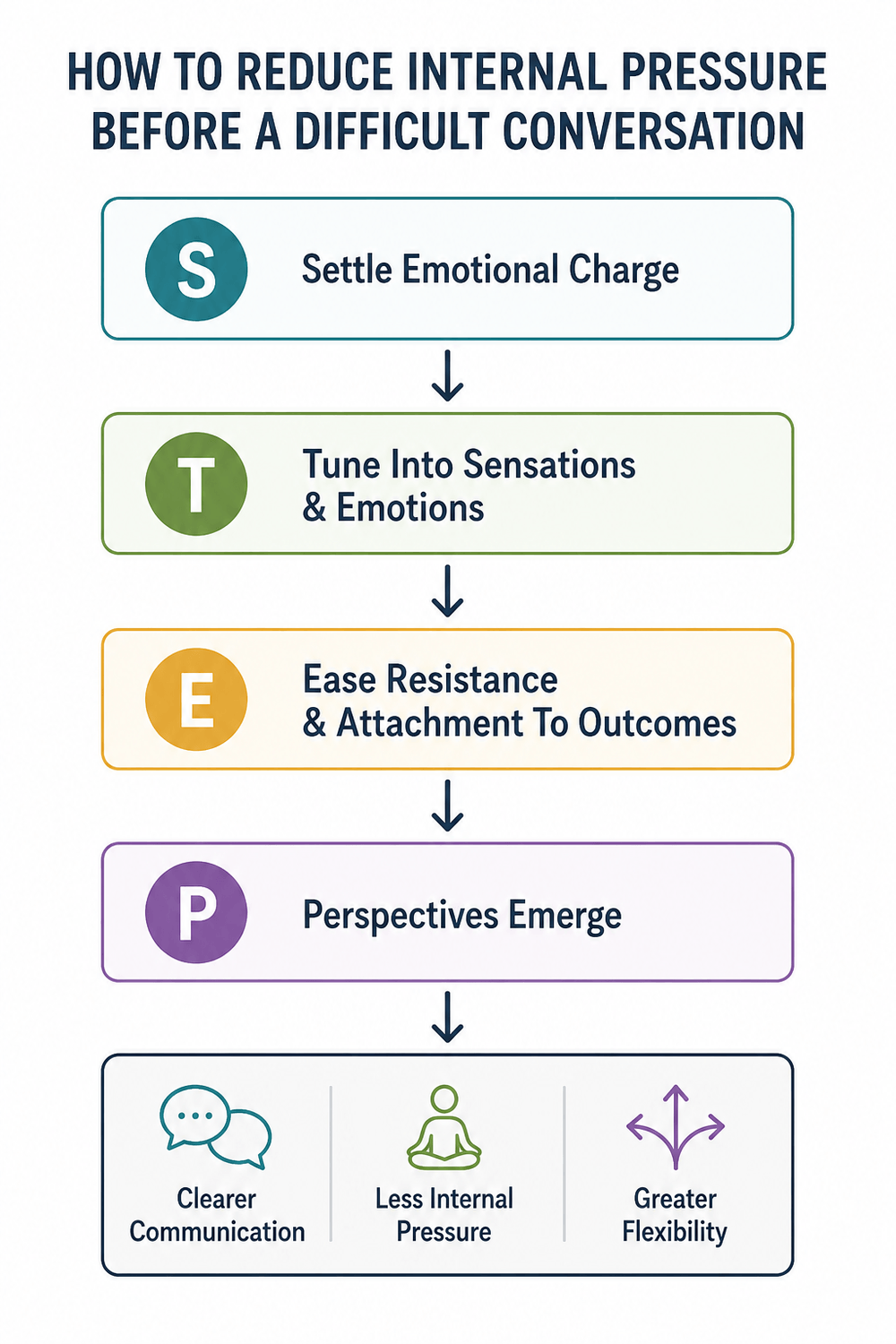
A Different Approach: The S.T.E.P. Process
Rather than trying to force a different mindset, it can be more helpful to reduce the pressure that is shaping the conversation in the first place.
One approach I use is a process called S.T.E.P.
S — Settle Emotional Charge
Before trying to think differently, begin by reducing the emotional intensity surrounding the conversation.
This is where EFT tapping can be particularly useful.
The goal is not to make the conversation disappear.
The goal is to reduce the sense of urgency, threat, or emotional weight attached to it.
When the emotional charge decreases, people often find they can think more clearly and respond more flexibly.
T — Tune Into Sensations and Emotions
Once some of the intensity has reduced, the next step is becoming curious about what is present.
What sensations do you notice?
What emotions are present?
What feels uncomfortable about the conversation?
Rather than immediately trying to change the experience, the aim is to understand it.
Often there is useful information beneath the initial tension.
E — Ease Resistance
Many difficult conversations involve some form of resistance.
Resistance to uncertainty.
Resistance to discomfort.
Resistance to a particular outcome.
This is also where attachment to outcomes often becomes visible.
You may notice a strong need for agreement.
A need to avoid criticism.
A need to control how the conversation unfolds.
As resistance softens, the conversation often begins to feel lighter.
Not because the situation has changed.
Because the struggle against the situation has reduced.
P — Perspectives Emerge
This final step is what makes the process different from simply positive thinking.
The goal is not to replace negative thoughts with positive thoughts.
The goal is to create enough space for new perspectives to emerge naturally.
As the emotional charge and resistance reduce, people often notice new possibilities becoming available.
Not because they forced them.
Because they can finally see them.
What Often Emerges
When people work through this process before a difficult conversation, they frequently discover things they couldn't access when the pressure was higher.
For example:
- Maybe agreement isn't necessary.
- Maybe I don't need the perfect words.
- Maybe this conversation isn't as significant as I made it.
- Maybe I can tolerate some discomfort.
- Maybe I don't need to control their reaction.
- Maybe my role is simply to communicate clearly.
These shifts are rarely created through force.
They often emerge naturally once the emotional charge surrounding the conversation begins to reduce.
What Becomes Possible
When internal pressure reduces, conversations often feel different before they even begin.
People frequently notice:
- less mental rehearsal
- less tension leading up to the conversation
- clearer thinking
- greater flexibility in the moment
- improved listening
- more direct communication
- less need to control the outcome
Importantly, reducing internal pressure does not guarantee a particular result.
The other person may still disagree.
The conversation may still feel uncomfortable.
The outcome may still be uncertain.
What changes is your relationship to the conversation.
Instead of carrying the full weight of every possible outcome, you can focus on what is actually within your control.
Over time, many people find that difficult conversations become less something they need to endure and more something they are capable of navigating.
Before Your Next Difficult Conversation
If you have an important conversation coming up, it may be worth asking yourself:
What am I carrying into this conversation?
What outcome am I attached to?
What am I trying to avoid?
Sometimes reducing internal pressure isn't about finding better words.
Sometimes it's about reducing the emotional weight that has accumulated around the conversation.
Because when that weight begins to lift, new perspectives, options, and responses often become available without forcing them.
A 5 Minute Reset Before Difficult Conversations
References
Church, D. (2019). The EFT Manual.
Feinstein, D. (2012). Acupoint Stimulation in Treating Psychological Disorders.
Kahneman, D. (2011). Thinking, Fast and Slow.
Siegel, D. J. (2010). The Mindful Therapist.
Tapping Success
EFT Practitioner in Melbourne, Australia.
I help capable professionals communicate, decide, and act more clearly under pressure.
Address
Mentone, Melbourne, Australia.
will@tappingsuccess.com


Schedule a Consultation
To schedule a consultation, simply fill out the form below, and I'll get back to you within 24 hours to confirm your appointment and discuss the details of your project further.