
Why Is It So Hard To Think Clearly When Everything Feels Urgent?
Why Is It So Hard To Think Clearly
When Everything Feels Urgent?
Exploring how pressure can influence communication in meetings, feedback conversations, leadership situations, and other important workplace interactions.
When Everything Feels Urgent
You begin the day with a clear plan.
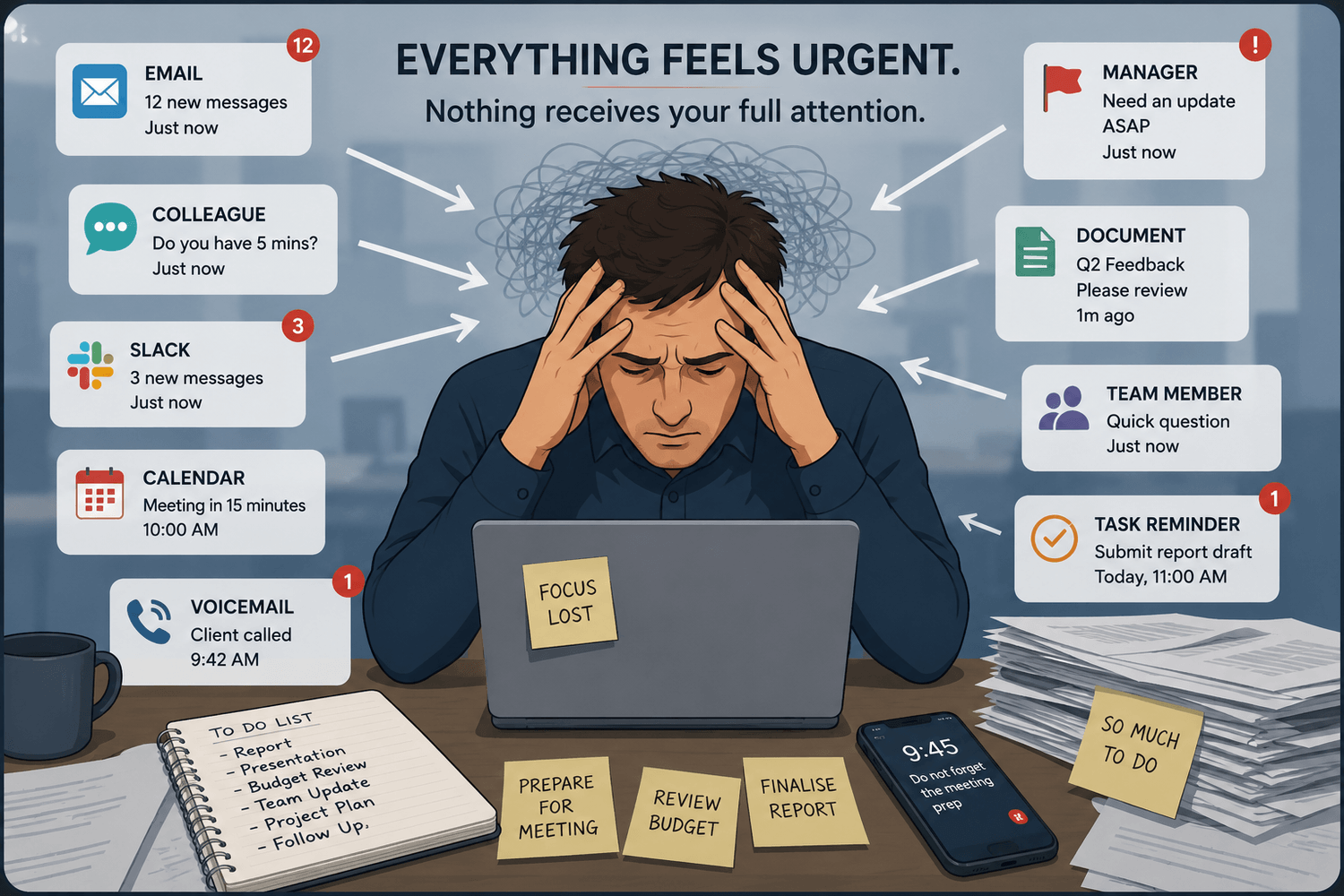
Before you’ve finished your first task, an email marked “urgent” arrives. A colleague asks if you have five minutes. Your manager wants an update. A client leaves a voicemail. A Teams notification appears. Then another. Your calendar reminds you about a meeting you haven’t prepared for.
None of these demands seem unreasonable on their own.
Together, they create a different experience.
By mid-morning, it feels as though everything needs your attention at once. You move from task to task without feeling like you’ve made real progress on any of them. You start one piece of work while thinking about three others. Even when you stop working for the day, your mind continues holding onto everything that still feels unfinished.
Many people describe this as being busy.
But often something else has happened.
Pressure has made everything feel equally important.
When Everything Starts Competing For Your Attention
Most workplaces involve competing priorities.
That is not unusual.
The challenge begins when your mind can no longer distinguish between what genuinely needs your attention now and what can safely wait until later.
An important presentation, an unread email, a routine administrative task, a colleague’s question and tomorrow’s deadline can all begin carrying the same emotional weight.
Everything starts feeling urgent.
Everything starts feeling important.
As that happens, attention becomes fragmented. Rather than focusing deeply on one piece of work, part of your mind remains attached to everything else you haven’t finished yet.
The workload may not have changed.
Your relationship with the workload has.
Why The Mind Tries To Hold Everything At Once
Overload Pressure develops when there are more competing demands than your attention comfortably feels able to manage.
The mind responds in a predictable way.
Instead of confidently deciding where attention belongs, it tries to keep everything active at the same time. Every unfinished task stays mentally open because letting go of it feels risky. You worry that if you stop thinking about it, you’ll forget something important or let someone down.
This creates a hidden workload.
You are no longer just doing your work.
You are also trying to remember every piece of work that still needs doing.
That constant mental switching is exhausting. It also makes clear thinking surprisingly difficult because attention is continually being pulled away before it has a chance to settle.
When everything feels like a priority, nothing receives your full attention
One of the hidden costs of Overload Pressure is that it changes the way attention works.
When every request feels equally significant, nothing receives your full attention for very long.
You begin reading one email while thinking about another meeting. You prepare for a presentation while wondering whether you’ve forgotten to reply to a client. During a conversation, part of your attention remains attached to the work waiting on your desk.
From the outside, this can look like poor concentration or disorganisation.
Internally, however, the experience is often very different.
Your attention is not absent.
It is divided.
That distinction matters because many professionals assume they have become less capable when, in reality, their attention has simply become spread across too many competing demands.
The Workload Isn’t The Whole Story
When people feel overwhelmed, they often assume the only solution is to reduce the amount of work they have.
Sometimes that is necessary.
But workload is only part of the picture.
Two people can have similar responsibilities and experience them very differently. One is able to decide what matters most, complete it, and then move on to the next task. The other feels mentally pulled towards every unfinished request throughout the day.
The difference is not always the number of tasks.
It is often the amount of pressure attached to those tasks.
Overload Pressure does not simply increase the amount of work.
It changes how difficult it becomes to decide where your attention belongs.
Helping Your Mind Separate Urgency From Importance
One of the most helpful shifts is recognising that feeling something is urgent is not the same as it actually being the highest priority.
Overload Pressure blurs that distinction.
A routine email can start feeling as important as preparing for tomorrow’s presentation. A notification can feel just as significant as the report you need to finish. Every unfinished task begins competing for the same limited attention.
The result is not simply a longer to-do list.
It is a mind that struggles to let go of anything.
Reducing Overload Pressure begins by settling the emotional urgency attached to everything that is asking for your attention.
The first stage of STEP, Settle Emotional Charge, is designed to help create that shift. Rather than trying to organise your workload while your mind is treating every demand as equally urgent, it helps settle the internal activation first.
As that emotional intensity begins to reduce, something important often changes.
The work itself may be exactly the same.
Your ability to distinguish what genuinely needs your attention begins to return.
Giving One Thing Your Full Attention Again
As Overload Pressure reduces, a different possibility becomes available.
You can give one thing your full attention again.
This does not mean ignoring everything else on your list. It means trusting that not every unfinished task needs to remain mentally active while you complete the one in front of you.
Many people are surprised by how much clearer they think when attention stops being divided between multiple competing demands.
Decisions become easier because fewer options are competing for immediate attention. Conversations become easier because your mind is no longer drifting towards everything waiting afterwards. Preparation becomes more productive because your attention has somewhere to settle instead of constantly switching between priorities.
The work has not become simpler.
Your relationship with the work has.
What Changes When Attention Stops Being Pulled In Every Direction
When Overload Pressure has less influence, the benefits extend well beyond feeling less busy.
People often find they finish important work more consistently because they are no longer continually interrupting themselves. They become more confident about deciding what can wait until later without feeling guilty. Meetings become more productive because their attention remains with the discussion rather than the growing list of unfinished tasks in the background.
Over time, many people notice they:
* prioritise more effectively
* complete meaningful work with fewer interruptions
* prepare more thoroughly for important conversations
* think more clearly when making decisions
* remain present during meetings
* leave work feeling mentally lighter instead of carrying every unfinished task home
Perhaps most importantly, they stop measuring productivity by how many things they are trying to manage at once.
They begin measuring it by how fully they can engage with what matters most.
Before Your Next Busy Day
Before opening your inbox or adding another task to your list, pause for a moment and ask yourself:
“Is everything truly a priority, or does everything simply feel urgent right now?”
The answer may reveal where some of the pressure is coming from.
If you notice your attention being pulled in every direction, spending a few minutes reducing the emotional intensity before planning your work can make prioritising feel much easier. The 5-Minute Reset Before Difficult Conversations introduces the STEP process, helping settle the internal pressure that makes every task feel equally urgent so you can focus your attention where it will have the greatest impact.
References
Ophir, E., Nass, C., & Wagner, A. D. (2009). Cognitive control in media multitaskers. Proceedings of the National Academy of Sciences, 106(37), 15583–15587.
Mark, G., Gudith, D., & Klocke, U. (2008). The cost of interrupted work: More speed and stress. Proceedings of the SIGCHI Conference on Human Factors in Computing Systems.
Baumeister, R. F., & Tierney, J. (2011). Willpower: Rediscovering the Greatest Human Strength.
Kahneman, D. (2011). Thinking, Fast and Slow.
Tapping Success
EFT Practitioner in Melbourne, Australia.
I help capable professionals communicate, decide, and act more clearly under pressure.
Address
Mentone, Melbourne, Australia.
will@tappingsuccess.com


Schedule a Consultation
To schedule a consultation, simply fill out the form below, and I'll get back to you within 24 hours to confirm your appointment and discuss the details of your project further.