
Why Is It So Hard To Talk To Someone After They’ve Criticised Me?
Why Is It So Hard To Talk To Someone
After They’ve Criticised Me?
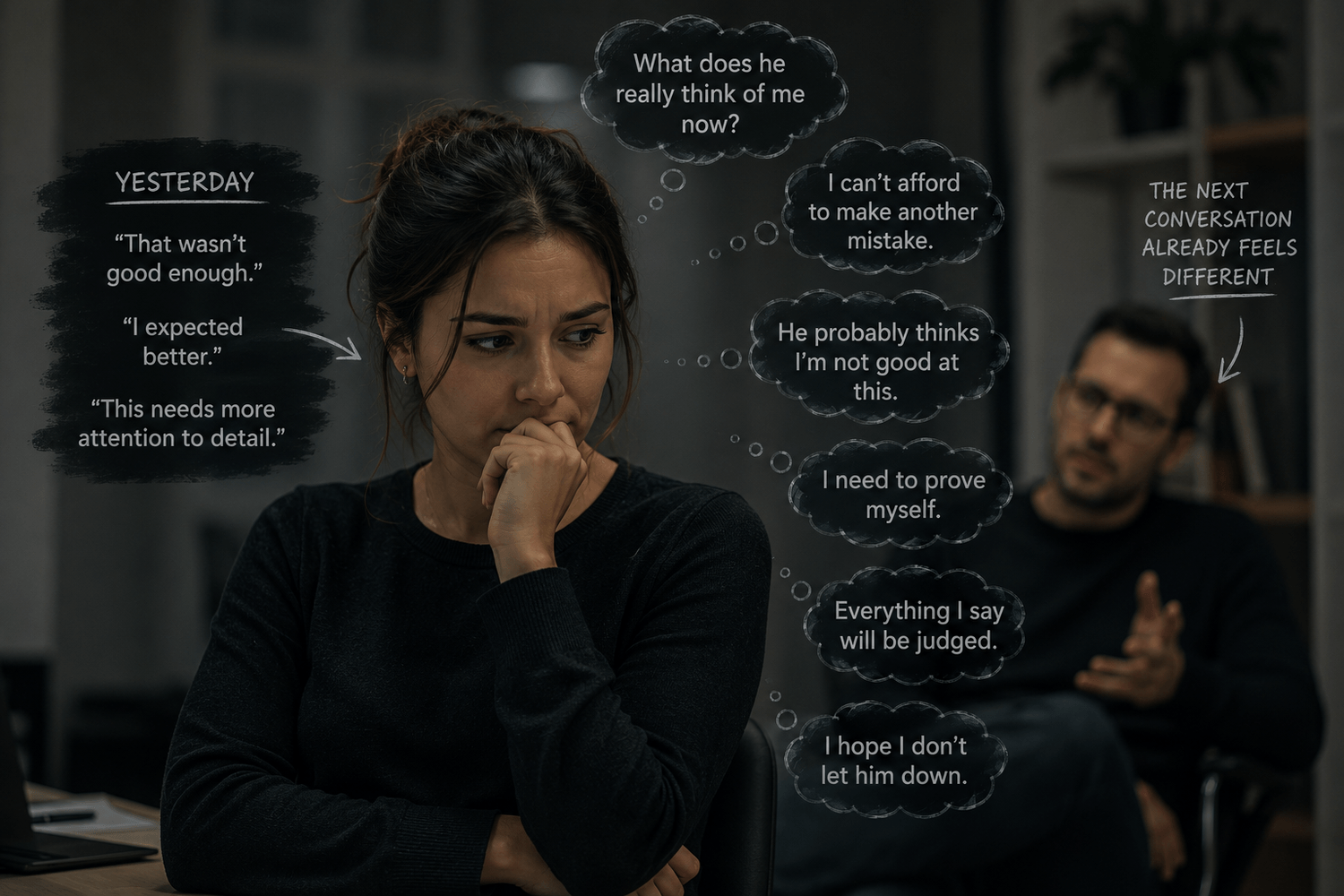
Exploring how pressure can influence communication in meetings, feedback conversations, leadership situations, and other important workplace interactions.
When The Next Conversation Already Feels Different
The criticism happened yesterday.
Perhaps your manager questioned your judgement during a meeting. A colleague complained about the way you handled a project. A client challenged your recommendation. Maybe you accidentally saw an email that wasn’t meant for you and realised someone had been speaking negatively about your work.
The conversation ended.
Yet something stayed with you.
The next time you see that person, the interaction feels different before either of you has spoken. You begin thinking about what to say. You rehearse simple conversations in your head. You become unusually aware of how you sound and how you might be coming across.
You may avoid eye contact, keep conversations brief, or work harder than usual to prove yourself. Sometimes you even find yourself analysing every interaction afterwards, searching for signs that the relationship has changed.
The criticism may have lasted only a few minutes.
The pressure can last much longer.
When Judgement Follows You Into The Next Conversation
Not every difficult interaction creates this response.
A disagreement with someone whose opinion means very little may be forgotten by the end of the day. Constructive feedback from a trusted colleague may even feel useful.
The experience often changes when you believe someone has formed a negative opinion of you.
Perhaps they think you are inexperienced.
Perhaps they now question your judgement.
Perhaps they see you differently than they did before.
Whether those beliefs are accurate or not, they can create Judgement Pressure.
Judgement Pressure develops when we believe another person’s opinion of us has changed, and that belief begins shaping how we communicate with them in future interactions.
The next conversation no longer feels like a fresh conversation.
It starts feeling like a continuation of the criticism.
When Attention Turns Towards Yourself
One consequence of Judgement Pressure is that attention quietly shifts.
Instead of focusing on the conversation itself, part of your attention begins monitoring how you are being seen.
You may wonder whether they still respect you. You might analyse every facial expression, every pause, or every brief reply for evidence that confirms what you already fear. A normal interaction starts carrying far more meaning than it otherwise would.
At the same time, communication often changes.
Some people become quieter because they do not want to make another mistake. Others over-explain simple points, hoping to demonstrate competence. Some work harder to appear confident, while others withdraw altogether.
Although these behaviours look very different on the surface, they often come from the same place.
The conversation has become less about communicating.
It has become more about managing an opinion you believe already exists.
The Criticism May Be Over. The Self-Monitoring Continues.
This is what makes Judgement Pressure so exhausting.
The criticism may have ended days ago.
The other person may not be thinking about it anymore.
Yet your mind continues preparing for it.
Every interaction becomes an opportunity to repair your image, avoid another mistake, or prove that the criticism was wrong. The conversation begins carrying a second job that wasn’t there before.
You are no longer simply talking to another person.
You are also managing your own self-monitoring.
That hidden workload consumes attention.
It becomes harder to listen naturally because part of your attention is occupied with how you are performing. It becomes harder to think clearly because another part of your mind is busy predicting how every word will be interpreted.
From the outside, the conversation may appear completely ordinary.
Internally, it feels anything but.
Yesterday’s Judgement Is Not Today’s Conversation
One difficult interaction can easily become the lens through which every future interaction is viewed.
Pressure quietly blends the two together.
The criticism happened once.
The mind begins experiencing it repeatedly.
That distinction matters because yesterday’s judgement and today’s conversation are not the same experience.
A critical comment does not mean every future interaction will be critical. Someone disagreeing with your work once does not mean every conversation now requires you to defend yourself. Even when criticism is fair, it does not need to become the defining feature of every future interaction.
Recognising this does not erase the criticism.
It simply prevents one moment from deciding the emotional tone of every conversation that follows.
When The Conversation Stops Carrying Yesterday’s Criticism
Reducing Judgement Pressure begins by loosening the connection between the criticism that happened and the conversation that is happening now.
Many people notice that practices such as EFT tapping or the STEP process help reduce the emotional charge that remains attached to the original criticism. Rather than trying to forget what happened or convince yourself that the criticism didn’t matter, the aim is to reduce how strongly yesterday’s experience shapes today’s communication.
The same is true of the 5-Minute Reset Before Difficult Conversations. Sometimes the conversation itself is not what feels difficult. It is everything that has been emotionally carried into it.
As that emotional weight begins to soften, something changes.
You become more able to respond to the person in front of you rather than the judgement you are expecting from them.
Yesterday’s judgement no longer needs to become today’s conversation.
Meeting The Person Instead Of The Judgement
As Judgement Pressure begins to reduce, a different possibility becomes available.
You become more able to meet the person instead of the judgement you believe they hold about you.
This is a subtle but important shift. Rather than walking into every interaction expecting to repair your reputation, you can begin treating each conversation as a new conversation. You no longer need to interpret every smile, every pause, or every brief reply as evidence that confirms what you fear they think.
This does not mean forgetting the criticism or pretending it never happened.
It means allowing the current interaction to be shaped by what is happening now rather than by what happened before.
The criticism may still have been valid.
The relationship may still require rebuilding.
But neither requires you to spend every conversation monitoring yourself instead of engaging with the other person.
When Attention Returns To The Conversation
As the emotional weight of previous judgement begins to ease, attention naturally returns to where it is most useful.
Instead of constantly asking, “What are they thinking about me?”, you become more able to ask, “What is this conversation asking of me?”
That change often feels surprisingly freeing.
People notice they listen more carefully instead of mentally rehearsing their next sentence. They answer questions more naturally because they are no longer trying to manage every impression they create. They stop searching for reassurance in every interaction and become more present with the conversation unfolding in front of them.
The criticism may still be remembered.
It simply stops dominating every future interaction.
What Changes Beyond The Next Conversation
When Judgement Pressure has less influence, the benefits extend far beyond one difficult relationship.
Professionals often recover more quickly after receiving criticism because they no longer carry it into every subsequent interaction. They become less likely to withdraw after difficult feedback or spend days trying to prove themselves through perfect performance. Conversations begin feeling more natural because they are no longer driven by constant self-monitoring.
Over time, many people notice they:
* speak more naturally after receiving criticism
* stop over-analysing routine interactions
* recover more quickly from negative feedback
* become less defensive when talking with the same person again
* contribute ideas without trying to prove their competence
* spend less time replaying conversations afterwards
Perhaps most importantly, criticism becomes one piece of information rather than the lens through which every future conversation is viewed.
That often changes workplace relationships more than the criticism itself ever could.
Before Your Next Conversation
Before speaking with someone who has criticised you, pause for a moment and ask yourself:
“Am I responding to the conversation that’s happening now, or to the judgement I’m expecting from yesterday?”
The answer may reveal where some of the pressure is coming from.
If you notice yourself carrying previous criticism into future conversations, the 5-Minute Reset Before Difficult Conversations can help reduce the emotional weight attached to that experience.
Rather than trying to erase the criticism, it helps you approach the next interaction with greater presence, making it easier to respond to the conversation in front of you instead of the one that has already finished.
References
Leary, M. R. (2007). Motivational and emotional aspects of the self. Annual Review of Psychology, 58, 317–344.
Dickerson, S. S., & Kemeny, M. E. (2004). Acute stressors and cortisol responses: A theoretical integration and synthesis of laboratory research. Psychological Bulletin, 130(3), 355–391.
Gilbert, P. (2009). The Compassionate Mind. Constable & Robinson.
Carver, C. S., & Scheier, M. F. (1998). On the Self-Regulation of Behavior. Cambridge University Press.
Tapping Success
EFT Practitioner in Melbourne, Australia.
I help capable professionals communicate, decide, and act more clearly under pressure.
Address
Mentone, Melbourne, Australia.
will@tappingsuccess.com


Schedule a Consultation
To schedule a consultation, simply fill out the form below, and I'll get back to you within 24 hours to confirm your appointment and discuss the details of your project further.