Why Do I Ramble When
Speaking To Senior Leaders?
Why Do I Ramble When
Speaking To Senior Leaders?
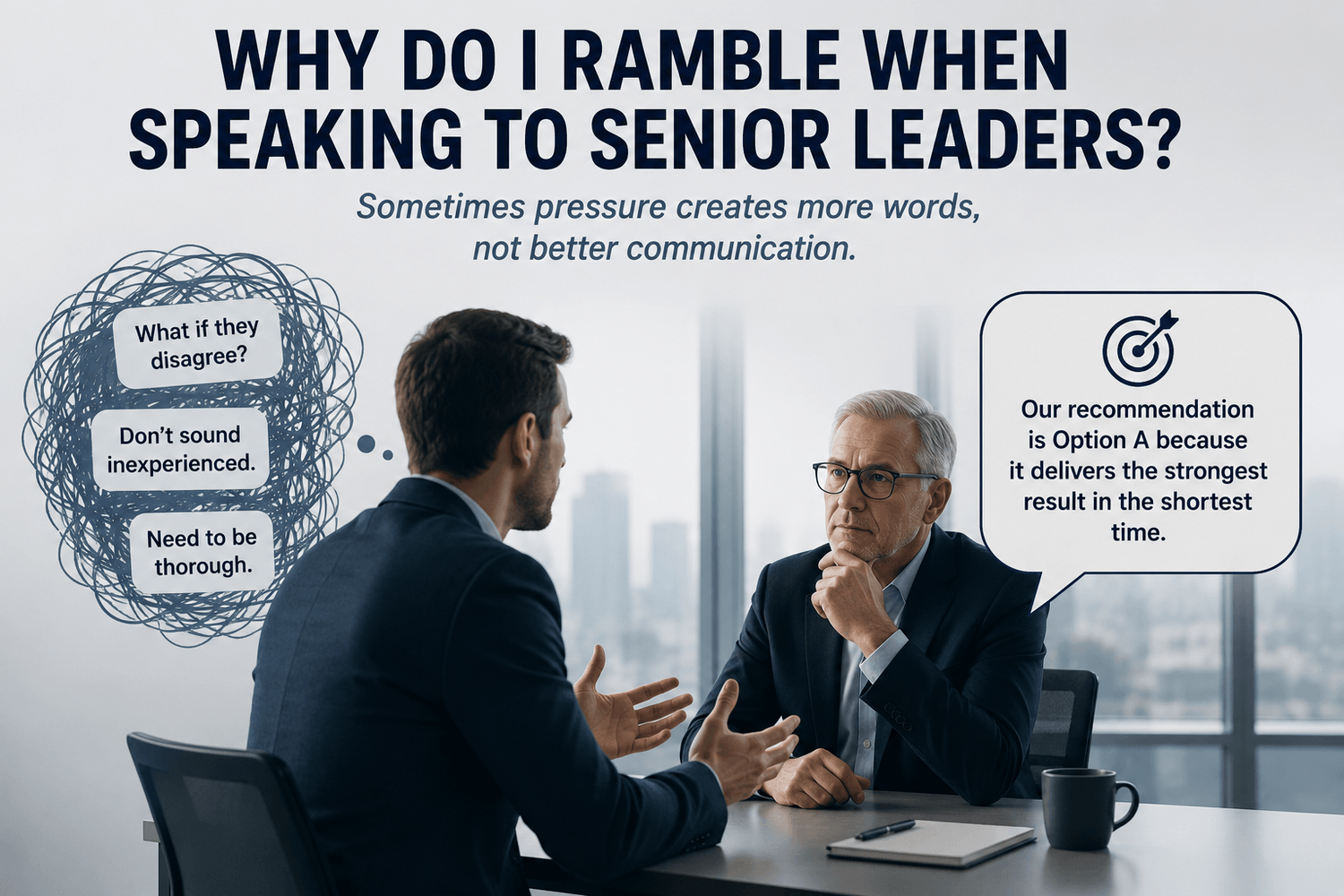
Exploring how pressure can influence communication in meetings, feedback conversations, leadership situations, and other important workplace interactions.
The question only needed a thirty-second answer.
A senior leader asked for your opinion.
You answered.
Then you kept going.
You added context.
You explained your reasoning.
You included background information.
Halfway through, you realised you had already made your point.
Yet somehow you were still talking.
Afterwards, you replayed the conversation and wondered why you couldn't have just said it more simply.
Many professionals assume this happens because they were unprepared.
But often the opposite is true. They knew exactly what they wanted to say.
Pressure changed how they said it.
When Authority Changes The Conversation
Not all conversations feel the same.
You can discuss an idea confidently with a colleague.
Then struggle to communicate that same idea clearly with a senior executive.
The information hasn't changed.
Your expertise hasn't changed.
The topic hasn't changed.
What has changed is the perceived significance of the interaction.
When someone has more authority, influence, or decision-making power, the conversation can start to feel more consequential.
Without consciously deciding to, your nervous system may begin treating the interaction differently.
The stakes appear higher.
The potential consequences feel larger.
The conversation starts carrying more weight.
This is a form of status pressure.
Status pressure isn't about status itself.
It's about what you believe the status of the other person means.
The more important the conversation feels, the more pressure can enter the interaction.
When A Conversation Starts Feeling Like An Evaluation
One reason status pressure can become so powerful is that the conversation often stops feeling like a conversation.
It starts feeling like an evaluation.
Questions that would normally feel straightforward begin carrying additional meaning.
You may find yourself thinking:
* What if I miss something important?
* What if they disagree?
* What if they think I don't understand the issue?
* What if I sound inexperienced?
* What if I don't answer well enough?
At this point, the conversation is no longer just about communicating information.
Part of your attention has shifted towards managing what the other person thinks about you.
Many professionals describe this as wanting to make a good impression.
But often something more specific is happening.
They are not trying to impress the other person. They are trying to avoid appearing incompetent.
That distinction matters.
Because avoiding a negative outcome often creates more pressure than pursuing a positive one.
Why Pressure Can Create More Words
When people think about pressure, they often imagine freezing, going blank, or staying silent.
Sometimes pressure does create silence. But pressure can also create excessive communication.
When a conversation feels important, the mind starts searching for safety.
One way it attempts to create that safety is through more information.
If one explanation feels risky, perhaps a longer explanation feels safer.
If one example feels insufficient, perhaps three examples will help.
If a recommendation feels exposed, perhaps adding more context will make it harder to challenge.
From the outside, this looks like rambling. From the inside, it often feels like being thorough.
The intention is usually protective.
The mind is attempting to reduce uncertainty and prevent negative judgement.
The problem is that more information is not always more helpful.
As pressure increases, it becomes harder to distinguish between information that improves understanding and information that simply reduces anxiety.
Communication expands.
More context.
More qualifications.
More background.
More justification.
Meanwhile, the central message becomes harder to find.
How Status Pressure Changes Communication
A common assumption is that conversations with senior leaders require more communication.
In reality, they often require more clarity.
Senior leaders are frequently making decisions across competing priorities, teams, projects, and time pressures.
They often need access to your thinking quickly.
Yet status pressure can quietly create a different objective.
Instead of communicating an idea, you start trying to demonstrate competence.
Instead of answering the question, you start proving you deserve to answer the question.
The focus shifts from:
"What do they need to know?"
to:
"What do I need to say so they don't think I'm wrong?"
That shift is subtle.
But it changes communication dramatically.
The stronger the need to avoid appearing incompetent, the harder it becomes to communicate simply.
Every sentence starts carrying additional weight.
Every point feels like it needs supporting evidence.
Every recommendation feels like it requires a defence.
The result is often more communication but less clarity.
A Different Way To Understand The Problem
If you find yourself rambling around authority figures, it does not automatically mean you lack confidence.
It does not necessarily mean you lack expertise.
And it does not mean you need a better script.
Often it means the perceived importance of the interaction has exceeded your ability to remain settled within it.
The challenge is not always communication. The challenge is the pressure underneath the communication.
This distinction matters because it changes where improvement comes from.
Many professionals respond by preparing more.
They rehearse.
Refine.
Edit.
Analyse.
Preparation can be useful.
But preparation alone cannot remove status pressure.
If the pressure remains unchanged, the same communication patterns often return despite knowing exactly what you want to say.
When Competence Stops Needing Constant Proof
Status pressure often creates a subtle shift in communication.
Instead of focusing on helping the other person understand, attention begins moving towards proving that you understand.
The difference can be difficult to notice in the moment.
A simple recommendation starts carrying the burden of demonstrating expertise. A concise answer starts feeling incomplete. Every statement begins to require supporting evidence, additional context, or further explanation.
The conversation quietly becomes a performance.
Reducing status pressure often begins by recognising that competence and proof are not the same thing.
Highly competent professionals do not demonstrate expertise by explaining everything they know. More often, they demonstrate expertise through relevance. They know what matters, what does not, and how to communicate the difference.
Many people find STEP useful before conversations with senior leaders because status pressure often creates an urge to earn credibility through additional explanation.
The process helps reduce some of the emotional weight attached to judgement, evaluation, and approval, making it easier to stay focused on the question rather than what the answer might say about you.
As that pressure begins to reduce, communication often becomes simpler. Not because you know less. Because you no longer feel responsible for proving everything you know.
The answer stops carrying the burden of demonstrating competence.
It can simply answer the question.
Creating More Space Before The Conversation
A useful question before an important interaction is:
"What feels at stake here?"
Not:
"What should I say?"
But:
"What am I trying to protect?"
The answer is often revealing.
Perhaps you are trying to prove yourself.
Perhaps you are trying not to disappoint someone.
Perhaps you are worried about losing credibility.
Perhaps you are carrying consequences that extend far beyond the conversation itself.
Recognising the pressure is often the first shift.
Once you can see what feels at stake, it becomes easier to work directly with the emotional charge behind it.
Some people use brief nervous system regulation practices before important conversations.
Others use approaches such as the STEP process to reduce emotional charge and create more internal space before speaking.
The specific method matters less than the outcome.
Less internal pressure often creates clearer communication.
What Becomes Possible
When status pressure reduces, something interesting happens.
You no longer need every sentence to carry the weight of proving yourself.
You can answer the question that was asked.
You can pause without rushing to fill the silence.
You can trust that a concise answer is often enough.
You can provide detail because it is useful, not because it feels emotionally necessary.
This doesn't mean becoming brief for the sake of brevity.
It means allowing relevance rather than pressure to determine how much you say.
The Outcome
When status pressure decreases, the benefits extend far beyond speaking more concisely.
Executive conversations become less exhausting.
You spend less time mentally editing yourself while speaking.
Recommendations become easier to make.
You trust your expertise more readily in the moment.
Senior leaders gain access to your actual thinking faster.
Your ideas become easier to understand.
Meetings require less recovery afterwards.
You spend less time replaying conversations in your head.
And perhaps most importantly, conversations with authority figures start feeling more like conversations and less like tests.
Because rambling is not always a sign that you don't know what to say.
Sometimes it is a sign that the conversation feels more significant than it needs to.
As that pressure reduces, communication often becomes naturally clearer.
Not because you've learned a better script.
But because you're no longer using extra words to create safety.
Before Your Next Conversation With A Senior Leader
If you’ve ever walked away from a conversation with a senior leader wishing you had said less, the issue may not be a lack of communication skill.
Sometimes pressure changes communication in the opposite way people expect.
Instead of becoming quiet, we add more detail, more explanation, and more information in an attempt to create safety.
Recognising these patterns is often the first step. Reducing the pressure underneath them can create even more change.
If you’d like a simple process to help reduce pressure before important conversations, presentations, meetings, or feedback discussions, download the free guide:
A 5-Minute Reset Before Difficult Conversations
References
Amy C. Edmondson (2019). The Fearless Organization: Creating Psychological Safety in the Workplace for Learning, Innovation, and Growth.
Robert M. Sapolsky (2004). Why Zebras Don’t Get Ulcers (3rd ed.).
Daniel Kahneman (2011). Thinking, Fast and Slow.
Steven Rogelberg (2019). The Surprising Science of Meetings: How You Can Lead Your Team to Peak Performance.
Tapping Success
EFT Practitioner in Melbourne, Australia.
I help capable professionals communicate, decide, and act more clearly under pressure.
Address
Mentone, Melbourne, Australia.
will@tappingsuccess.com


Schedule a Consultation
To schedule a consultation, simply fill out the form below, and I'll get back to you within 24 hours to confirm your appointment and discuss the details of your project further.