
Why Do I Avoid Giving Feedback?
Why Do I Avoid Giving Feedback?
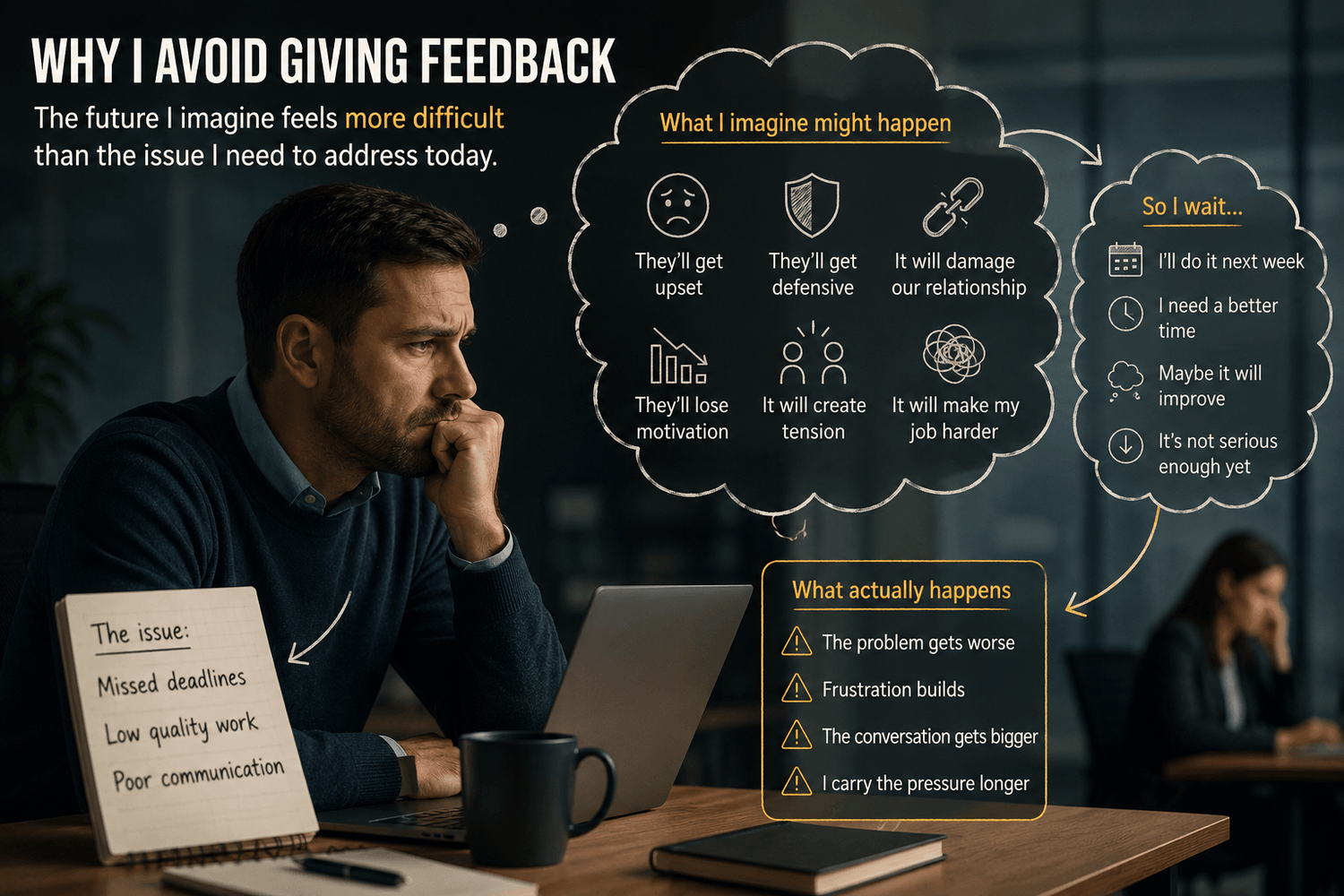
Exploring how pressure can influence communication in meetings, feedback conversations, leadership situations, and other important workplace interactions.
When The Conversation Stays On Your To-Do List
Most managers can think of a conversation they know they need to have.
An employee keeps missing deadlines. A team member’s behaviour is creating friction. Someone is not meeting expectations. A problem has become noticeable enough that it probably needs addressing.
Yet the conversation never quite seems to happen.
You tell yourself you’ll raise it next week. You decide to wait for a better opportunity. You hope the issue improves by itself. You convince yourself it isn’t serious enough yet. Sometimes you start the conversation but soften the feedback so much that the real issue never gets discussed.
Meanwhile, the problem remains.
What makes this frustrating is that most people already know what they need to say. The difficulty is not usually a lack of communication skill. The difficulty is often the pressure that builds around the conversation before it ever takes place.
The Future Starts Feeling Bigger Than The Issue
Many people assume feedback feels difficult because of what is happening today.
In reality, much of the pressure comes from the future they imagine after the conversation.
A manager may picture an employee becoming upset. They may imagine defensiveness, tension, awkwardness, disengagement, complaints, or an ongoing deterioration in the working relationship. They may worry that managing the person will become harder rather than easier.
None of those things have happened.
Yet the possibility of them happening can create significant pressure.
The conversation stops being about today’s issue and starts becoming about tomorrow’s potential problems.
The more vividly people imagine those future consequences, the harder the conversation often feels.
When Solving The Problem Starts Feeling Riskier Than Keeping It
This is where future pressure begins to take hold.
The original issue may be relatively straightforward. Someone needs clearer expectations. A behaviour needs correcting. A performance issue needs discussing.
Objectively, these are often manageable problems.
But as future pressure builds, the conversation itself starts feeling more dangerous than the issue it is meant to solve.
Attention shifts away from the actual problem and towards imagined outcomes:
* What if they react badly?
* What if they become difficult to manage?
* What if they lose motivation?
* What if the relationship changes?
* What if the situation becomes even harder?
At that point, avoiding the conversation can feel like the safer option.
Not because the problem has disappeared.
Because the imagined future has become larger than the issue itself.
Why Waiting Usually Increases The Pressure
The irony is that delay rarely reduces pressure.
Most unresolved issues continue to develop.
Missed deadlines become a pattern. Poor performance becomes normalised. Frustrations accumulate. Expectations become less clear. Resentment quietly builds on both sides.
The conversation that could have been ten minutes long last month often becomes a much larger conversation three months later.
Many managers eventually find themselves carrying two burdens.
The first burden is the original issue.
The second burden is the growing pressure created by avoiding it.
This is one reason feedback conversations can feel surprisingly heavy. The conversation is no longer carrying one problem. It is carrying every week that the problem remained unresolved.
The Future You Fear Is Only One Possible Future
Future pressure has a tendency to narrow attention.
People become highly focused on what could go wrong. They imagine conflict, disappointment, awkwardness, and tension. Their mind begins preparing for the most uncomfortable outcomes.
What often gets overlooked is that many feedback conversations do not unfold the way people imagine.
The employee may appreciate the clarity. The issue may be easier to resolve than expected. The conversation may strengthen trust because expectations are finally being discussed openly. The employee may even feel relieved that someone addressed an issue that had been sitting in the background.
The future being imagined is possible.
It is just not the only possibility.
This matters because pressure often treats imagined futures as certainty.
The Conversation May Create Discomfort. Avoiding It May Create A Larger Problem.
This is the central reframe.
The conversation may create discomfort. Avoiding it may create a larger problem.
Many managers delay feedback because they are trying to avoid a difficult future.
Ironically, avoidance often creates the very future they hoped to prevent.
Small concerns become significant performance issues. Minor frustrations become ongoing resentment. Clarifications become corrective conversations. Simple feedback becomes a formal intervention.
The conversation feels larger because the problem has been given time to grow.
Reducing Future Pressure
Future pressure is difficult to solve through more thinking.
Thinking is often what creates it.
The mind keeps generating new scenarios, new reactions, and new reasons to wait. Each imagined outcome adds another layer of pressure to a conversation that has not even happened yet.
This is where reducing internal pressure can be helpful.
When the emotional weight attached to the imagined future begins to reduce, attention can return to the issue that exists today. The conversation often starts looking more manageable because it is no longer carrying dozens of hypothetical outcomes.
This is one reason practices such as STEP, EFT Tapping, or the 5-Minute Reset Before Difficult Conversations can be useful. They are not designed to guarantee a particular outcome. They help reduce the pressure created by imagined futures so you can focus on the conversation that actually needs to happen.
Resolving Problems While They Are Still Easy To Resolve
As future pressure reduces, a different possibility becomes available.
You can address problems while they are still easy to resolve.
This is not about becoming more confrontational. It is not about enjoying difficult conversations. It is not about delivering feedback more aggressively.
It is about responding to issues while they are still proportionate to the conversation required.
Managers often discover that feedback becomes simpler when it happens earlier. Expectations can be clarified before misunderstandings become habits. Performance concerns can be discussed before they become formal performance problems. Team tensions can be addressed before they become interpersonal conflicts.
The conversation remains small because the problem is still small.
What Changes Beyond The Feedback Conversation
The benefits extend far beyond a single conversation.
Employees receive clearer expectations because concerns are raised earlier. Teams spend less time navigating unresolved tensions. Managers stop carrying conversations around in their heads for weeks or months at a time.
The mental load often decreases significantly.
Instead of repeatedly wondering whether they should raise an issue, managers can focus their attention on helping people improve. Instead of rehearsing difficult conversations, they can have them. Instead of managing around problems, they can address them directly.
Relationships often improve as well.
Many people assume feedback damages relationships. In practice, relationships are frequently damaged by the absence of feedback. Unspoken frustrations create distance. Unclear expectations create confusion. Avoided conversations create resentment.
Honest feedback, delivered respectfully, often creates greater trust because people know where they stand.
The outcome is not simply becoming better at feedback.
The outcome is preventing small issues from becoming large problems.
When that happens, conversations become shorter, expectations become clearer, trust becomes stronger, and management becomes significantly easier.
Before Your Next Feedback Conversation
Ask yourself:
“Am I responding to the issue that exists today, or the future I am imagining might happen?”
The answer may reveal where some of the pressure is coming from.
The 5-Minute Reset Before Difficult Conversations is a short guided exercise designed to help reduce internal pressure so you can remain connected while expressing a different view when it matters.
References
Amy Edmondson. Research on psychological safety and speaking up.
Kim Scott. Radical Candor.
Douglas Stone & Sheila Heen. Difficult Conversations and Thanks for the Feedback.
Joseph Grenny et al. Crucial Conversations.
Tapping Success
EFT Practitioner in Melbourne, Australia.
I help capable professionals communicate, decide, and act more clearly under pressure.
Address
Mentone, Melbourne, Australia.
will@tappingsuccess.com


Schedule a Consultation
To schedule a consultation, simply fill out the form below, and I'll get back to you within 24 hours to confirm your appointment and discuss the details of your project further.