
Why Do Difficult Conversations Feel
Bigger Than They Need To?
Why Do Difficult Conversations Feel
Bigger Than They Need To?
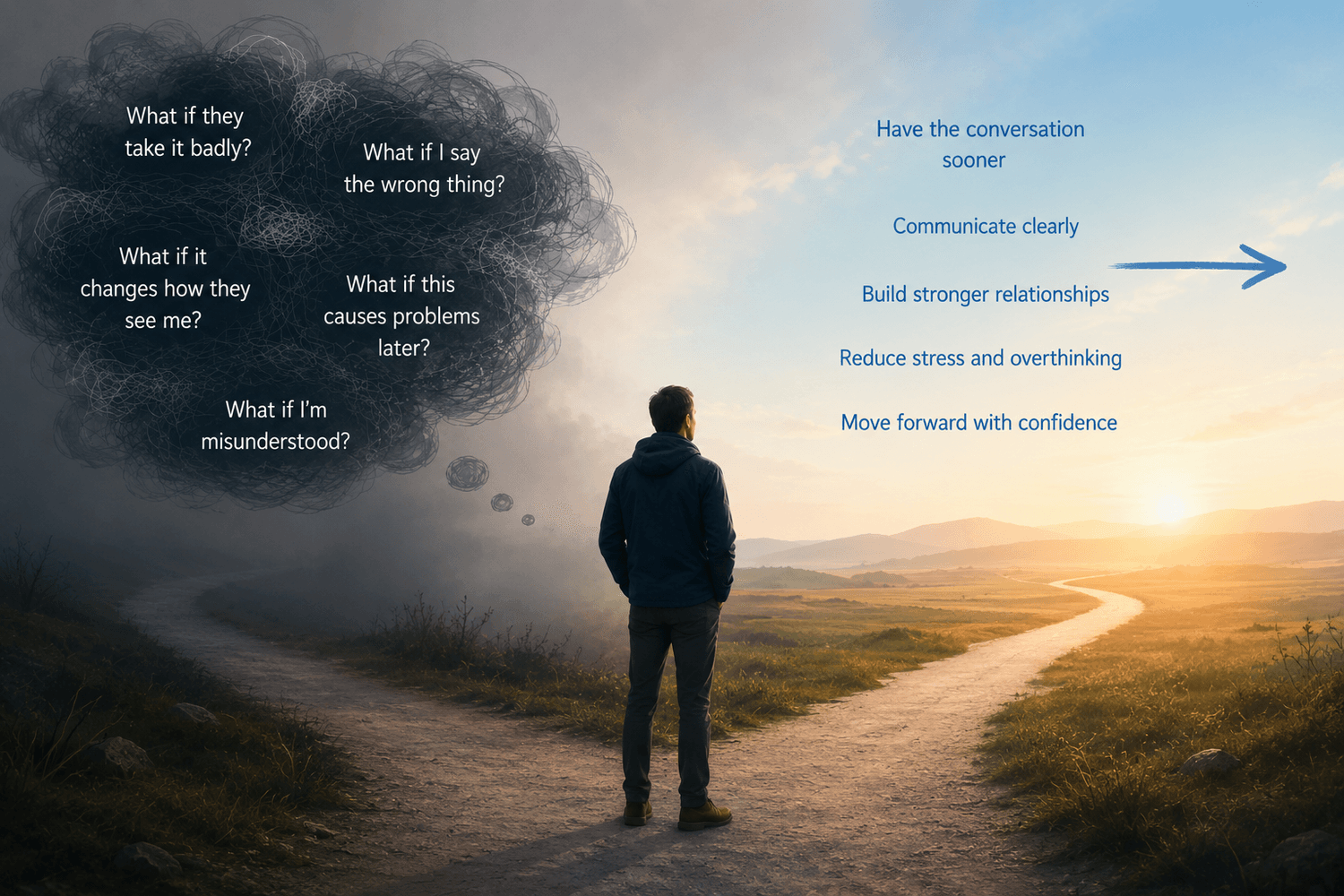
Exploring how pressure can influence communication in meetings, feedback conversations, leadership situations, and other important workplace interactions.
There are conversations that happen.
And there are conversations that live in your head for days beforehand.
A discussion with a manager.
Feedback for a colleague.
A conversation about expectations.
A difficult decision.
An uncomfortable disagreement.
The conversation itself may only last ten minutes.
Yet it can occupy hours of thought beforehand.
You think about how to begin.
You imagine how the other person might respond.
You rehearse different versions.
You revisit possible outcomes.
By the time the conversation arrives, it can feel much larger than the actual discussion taking place.
Many professionals assume this means the conversation is genuinely high-risk.
But often something else is happening.
The Conversation Starts Long Before The Conversation
One reason difficult conversations can feel overwhelming is that they rarely remain confined to the conversation itself.
Instead, they become attached to a range of possible consequences.
A simple piece of feedback can become:
"What if they take it personally?"
A disagreement can become:
"What if this damages the relationship?"
A request can become:
"What if they think I'm unreasonable?"
The conversation gradually expands beyond what is actually happening.
The discussion is no longer just about the issue.
It becomes connected to reputation, approval, belonging, competence, status, or future outcomes.
As the perceived significance grows, so does the pressure.
The Mind Is Designed To Predict
Human beings naturally anticipate future events.
This is useful.
It helps us prepare. It helps us identify potential problems. It helps us avoid unnecessary risks.
The challenge is that prediction is not reality.
Before an important conversation takes place, the mind often begins filling in information that doesn't yet exist.
Possible reactions.
Possible misunderstandings.
Possible consequences.
Possible problems.
The more important the conversation feels, the more detailed these predictions can become.
The conversation starts to feel stressful not because of what has happened, but because of what might happen.
When Significance Expands, Pressure Expands
Two conversations can be almost identical on the surface.
One feels manageable. The other feels overwhelming.
The difference is often not the content of the discussion.
It is the meaning attached to it.
A conversation about a missed deadline may feel relatively straightforward.
The same conversation may feel far more difficult if it becomes associated with:
- being respected
- being liked
- being seen as competent
- protecting a relationship
- protecting a career opportunity
The issue itself remains the same.
The significance surrounding it becomes much larger.
As significance expands, pressure often follows.
Why Avoidance Can Feel Attractive
When a conversation feels bigger than it needs to, avoidance often begins to make sense.
Not because someone lacks courage. Not because they are unwilling to communicate.
But because the conversation now appears far more consequential than it actually is.
People delay.
They gather more information.
They wait for a better moment.
They hope the issue resolves itself.
Sometimes they convince themselves the conversation is no longer necessary.
Yet the issue often remains.
And the pressure frequently remains with it.
In some cases, the anticipation becomes more exhausting than the conversation would have been.
A Different Way To View Difficult Conversations
Many people assume the goal is to eliminate discomfort.
That is rarely realistic.
Important conversations often involve uncertainty.
What can change is the amount of significance attached to the conversation.
Instead of viewing the discussion as a defining moment, it can be helpful to view it as what it actually is:
A conversation.
An exchange of information.
An opportunity to clarify, understand, solve, discuss, or decide something.
Not every conversation determines the future of a relationship.
Not every disagreement becomes conflict.
Not every piece of feedback creates resentment.
Often the mind creates outcomes that never occur.
What Becomes Possible
When difficult conversations stop carrying so much imagined weight, something interesting often happens.
The conversation itself doesn’t necessarily change.
The topic may still be uncomfortable.
The outcome may still be uncertain.
But the amount of energy required to approach it begins to decrease.
People often find themselves addressing issues sooner rather than carrying them for weeks.
Conversations that once felt intimidating start to feel manageable.
Preparation becomes simpler because there is less pressure to predict every possible outcome.
Instead of mentally rehearsing dozens of scenarios, attention can return to what actually needs to be discussed.
Many people also notice that they become more present during important conversations.
Rather than trying to control every possible reaction, they can focus on listening, responding, and thinking in real time.
Over time, this can create a different relationship with difficult conversations altogether.
Instead of seeing them as events to endure, they become conversations that can be approached, navigated, and completed.
The result is often more than better communication.
People frequently experience less mental exhaustion, less anticipatory stress, and less time spent carrying conversations around in their heads before they happen.
And when difficult conversations feel smaller, it becomes easier to have them when they matter.
Issues get addressed earlier.
Expectations become clearer.
Relationships often benefit from fewer unspoken assumptions.
Important conversations stop occupying so much mental space.
Not because every conversation becomes easy.
But because they no longer need to feel bigger than they really are.
Before Your Next Difficult Conversation
If a conversation has been occupying your thoughts for days, it may be worth asking:
Is the pressure coming from the conversation itself?
Or from everything I have attached to it?
Sometimes the conversation is difficult.
But sometimes the conversation has simply become bigger in anticipation than it is likely to be in reality.
Reducing that gap can make important conversations feel more approachable and allow you to communicate more clearly when they matter.
If you'd like a simple process to help reduce internal pressure before important conversations, presentations, meetings, and feedback discussions, download the free guide:
A 5 Minute Reset Before Difficult Conversations
References
Thinking, Fast and Slow – anticipation, prediction, and cognitive biases in decision-making.
Affective Forecasting – research showing people often overestimate the emotional impact of future events.
Timothy Wilson and Daniel Gilbert – foundational work on affective forecasting and future prediction errors.
Tapping Success
EFT Practitioner in Melbourne, Australia.
I help capable professionals communicate, decide, and act more clearly under pressure.
Address
Mentone, Melbourne, Australia.
will@tappingsuccess.com


Schedule a Consultation
To schedule a consultation, simply fill out the form below, and I'll get back to you within 24 hours to confirm your appointment and discuss the details of your project further.